How the Rule of 72 works
Years to double ≈ 72 ÷ interest rate
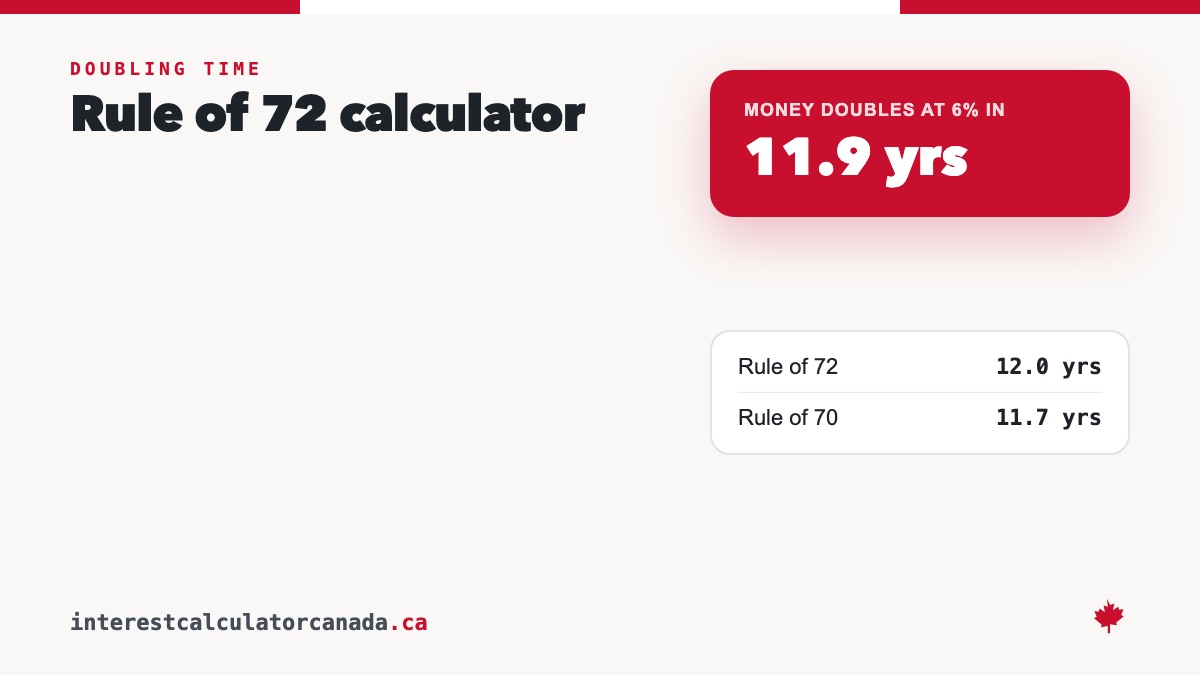
At 6%, money doubles in about 72 ÷ 6 = 12 years. The exact answer for annual compounding is ln 2 ÷ ln(1.06) = 11.9 years — the shortcut is remarkably close for typical rates.
Doubling times (annual compounding)
| Rate | Rule of 72 | Exact years |
|---|---|---|
| 1% | 72.0 | 69.66 |
| 2% | 36.0 | 35.00 |
| 3% | 24.0 | 23.45 |
| 4% | 18.0 | 17.67 |
| 5% | 14.4 | 14.21 |
| 6% | 12.0 | 11.90 |
| 8% | 9.0 | 9.01 |
| 10% | 7.2 | 7.27 |
| 12% | 6.0 | 6.12 |
Other uses
- Inflation: at 3% inflation, prices double in about 24 years.
- Debt: a balance at 20% doubles in under 4 years if nothing is paid — see the credit card calculator.
- Rule of 70: slightly more accurate for low rates and continuous compounding.
For a full projection with deposits, use the compound interest calculator.
Frequently asked questions
How accurate is the Rule of 72?
Very accurate between about 4% and 12% with annual compounding. At very low or high rates the error grows.
What is the Rule of 70?
The same idea with 70 instead of 72. It is closer for low rates and continuous compounding.
How long does it take to double money at 5%?
About 14.2 years with annual compounding; the Rule of 72 gives 14.4.
Results are estimates based on the figures you enter and assume rates do not change. They are not financial advice.